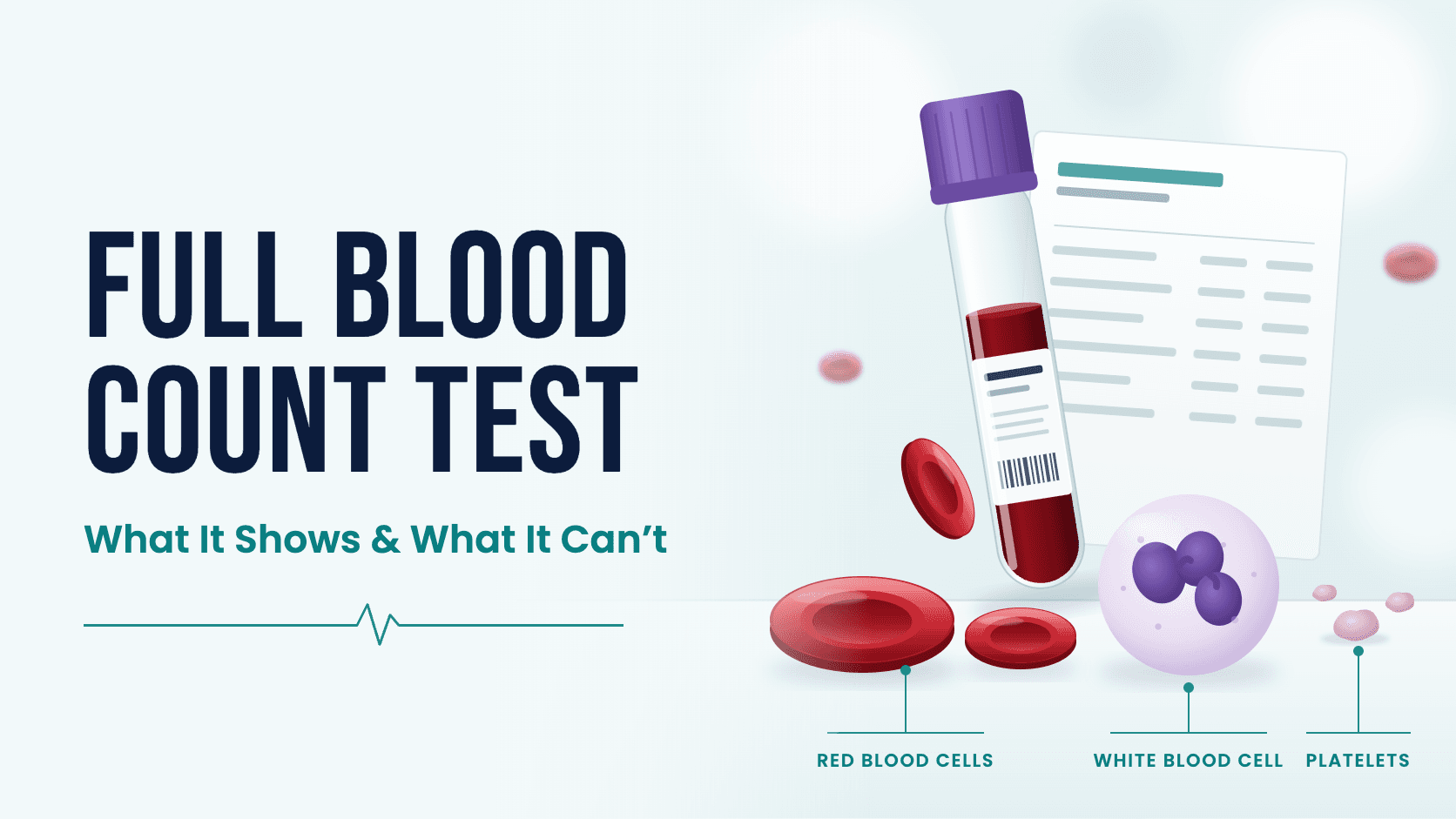

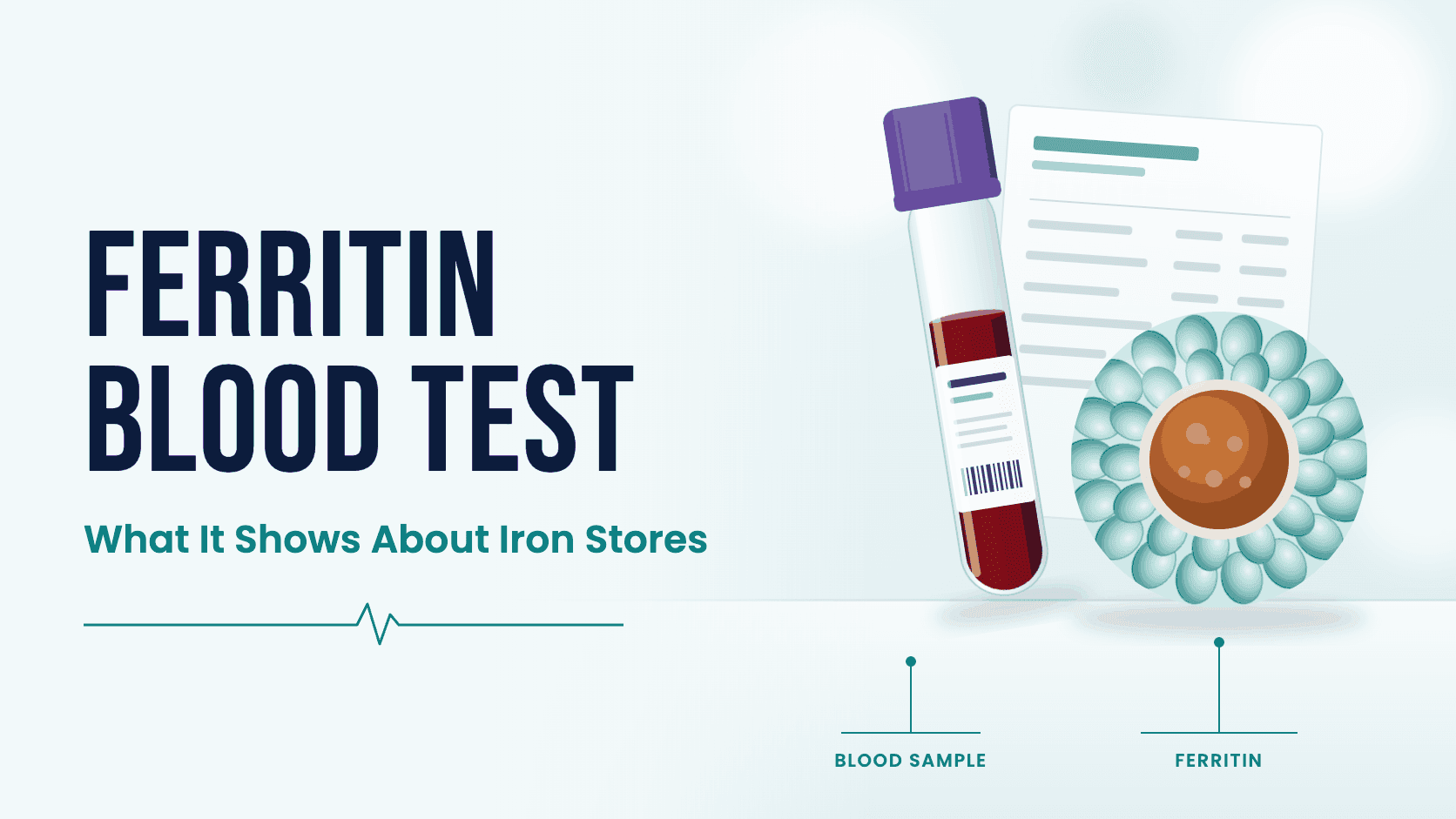
Ferritin is the main protein your body uses to store iron inside its cells (Lab Tests Online UK). A small amount also circulates in your blood, and measuring it is the most reliable blood test for judging how much iron you have stored (NICE CKS). It's usually done to find out whether you're low in iron, for example if you've been feeling unusually tired, or if another blood test suggests you might be anaemic.
A low result usually means your iron stores are low. A normal or high result can be harder to interpret, because ferritin also rises with infection, inflammation and some other conditions. This guide explains how the test works, how results are read and what to do next.
How ferritin compares with other blood tests
Ferritin is often checked alongside other blood tests. Each one tells you something different, and ferritin can fall before the others change (Lab Tests Online UK).
Test | What it tells you |
|---|---|
Ferritin | How much iron you have in storage. Inflammation can raise it |
Haemoglobin | Whether you're anaemic, but not why |
Full blood count | The number and size of your blood cells. Can suggest low iron, but can't confirm it |
Serum iron | The iron in your blood at that moment. It varies through the day |
Transferrin saturation | How much of the blood's iron-carrying protein is carrying iron |
Sources: NICE CKS; Lab Tests Online UK.
Why you might be offered a ferritin test
A ferritin test is often the next step after a full blood count. If that shows a low level of haemoglobin (the oxygen-carrying part of red blood cells), particularly with smaller-than-usual red cells, guidance recommends checking ferritin to see whether low iron is the reason (NICE CKS). Red cell size appears on your report as the mean cell volume, or MCV. Our guides explain what a full blood count shows and what an MCV result means.
It may also be suggested because of symptoms. Tiredness, shortness of breath and headaches are common with anaemia, and low iron can cause tiredness, poor concentration and irritability even without anaemia (NICE CKS). These symptoms have many possible causes, so a test helps to rule low iron in or out.
Some situations make low iron more likely, including periods (the most common cause of iron deficiency anaemia before the menopause), pregnancy, blood loss from the gut, conditions that affect how iron is absorbed, such as coeliac disease, and blood donation. Diet can contribute, but in adults it's rarely the whole explanation, which is why a clinician will usually look for other reasons too (NICE CKS).
Understanding your result
Reference ranges
Ferritin is usually reported in micrograms per litre (µg/L) next to a reference range set by the laboratory that tested your sample. Ranges and cut-off points vary between laboratories, so the range printed on your own report is the one to compare with.
Low ferritin
A low ferritin level usually means your iron stores are low. Clinical guidance treats a level below 30 µg/L as confirming iron deficiency, when it's read alongside the rest of someone's assessment (NICE CKS).
You can have low ferritin while your haemoglobin is still normal. This is called iron deficiency without anaemia, and it can still cause symptoms, especially in women who have periods.
Normal or high ferritin
Infection, inflammation, liver disease and some cancers can all push ferritin up, whatever the state of your iron stores. So a normal result doesn't always rule out low iron, particularly if you have a long-term inflammatory condition. A result that isn't clearly low sometimes needs further tests before its meaning is clear (NICE CKS).
A high ferritin doesn't necessarily mean too much iron either. Possible causes include inflammation, liver or kidney disease, some cancers and iron overload, where too much iron builds up in the body (British Society for Haematology). Iron overload can be caused by an inherited condition called haemochromatosis, which makes the body absorb too much iron from food, or by taking too much iron as a supplement (Lab Tests Online UK).
To work out what's going on, a clinician may look at other markers, such as C-reactive protein (CRP), which shows inflammation, and transferrin saturation, which is a key test when ferritin is unexpectedly high (NICE CKS; British Society for Haematology).
If you've had a full iron profile
An iron profile measures ferritin alongside other iron markers, and they tend to move together in recognisable patterns. In iron deficiency, ferritin, serum iron and transferrin saturation are usually low, while total and unsaturated iron-binding capacity (how much iron your blood could carry, and how much of that capacity is spare) are usually high. In haemochromatosis the pattern is broadly reversed (Lab Tests Online UK). Real results don't always fit neatly, especially when inflammation is present.
If you're pregnant
Ferritin is a reliable guide to iron stores early in pregnancy, as long as there's no infection or inflammation. It becomes less useful in the second and third trimesters, because ferritin naturally falls as pregnancy progresses, whatever your iron stores (NICE CKS). Your midwife or maternity team can advise on iron checks during pregnancy.
What to do next
A ferritin result is most useful when it's read alongside your symptoms, your medical history and your other results, so share it with a doctor or pharmacist rather than relying on the number alone.
If your iron is low, treatment and finding the cause usually go together. Treatment doesn't normally wait for further tests, but the reason still matters (NICE CKS). Which further tests you're offered depends on your age, sex and history. For example, men and women after the menopause are more likely to need further investigation, because blood loss from the gut is the most common cause in these groups (NICE CKS).
Please get advice before starting iron supplements yourself, so that any treatment suits you and the cause isn't missed. If you already take iron or any other supplement, mention it when you have your test, but don't stop a prescribed medicine or supplement unless a healthcare professional advises you to.
If you feel unwell or are worried about a symptom, don't wait for a test: speak to a doctor or call 111. In an emergency, call 999.
Having an iron test at our Whitefield clinic
If you'd like to check your iron stores, our Iron Status Profile measures ferritin together with serum iron, transferrin saturation, and total and unsaturated iron-binding capacity. It's a 15-minute appointment at our clinic at 210 Bury New Road, Whitefield, Manchester, M45 6GG, and costs £49. You can book if you're aged 16 or over and live in the UK.
When you book, you'll give us your email address. We'll send your booking confirmation there, along with access to your results.
Book the Iron Status Profile online, or get in touch if you'd like to ask us anything first.
Sources
- NICE Clinical Knowledge Summaries: anaemia, iron deficiency (investigations), last revised July 2026
- NICE Clinical Knowledge Summaries: anaemia, iron deficiency (signs and symptoms), last revised July 2026
- NICE Clinical Knowledge Summaries: anaemia, iron deficiency (causes), last revised July 2026
- NICE Clinical Knowledge Summaries: anaemia, iron deficiency (confirmed deficiency), last revised July 2026
- NICE Clinical Knowledge Summaries: anaemia, iron deficiency (management), last revised July 2026
- British Society for Haematology: investigation and management of a raised serum ferritin (British Journal of Haematology, 2018)
- Lab Tests Online UK: ferritin test and iron tests, from the Association for Laboratory Medicine
Frequently asked questions
What does a ferritin blood test measure?+
Ferritin is the main protein your body uses to store iron inside its cells. A small amount also circulates in your blood, and measuring it is the most reliable blood test for judging how much iron you have stored.
Is a ferritin test the same as an iron test?+
Ferritin is often checked alongside other blood tests. Each one tells you something different, and ferritin can fall before the others change. Ferritin shows how much iron you have in storage. Serum iron shows the iron in your blood at that moment, and it varies through the day.
What does a low ferritin level mean?+
A low ferritin level usually means your iron stores are low. Clinical guidance treats a level below 30 µg/L as confirming iron deficiency, when it's read alongside the rest of someone's assessment.
Can my ferritin be normal even if I'm low in iron?+
Infection, inflammation, liver disease and some cancers can all push ferritin up, whatever the state of your iron stores. So a normal result doesn't always rule out low iron, particularly if you have a long-term inflammatory condition.
Does a high ferritin mean I have too much iron?+
A high ferritin doesn't necessarily mean too much iron. Possible causes include inflammation, liver or kidney disease, some cancers and iron overload, where too much iron builds up in the body.
Is a ferritin test reliable in pregnancy?+
Ferritin is a reliable guide to iron stores early in pregnancy, as long as there's no infection or inflammation. It becomes less useful in the second and third trimesters, because ferritin naturally falls as pregnancy progresses, whatever your iron stores.
Should I start taking iron if my ferritin is low?+
Please get advice before starting iron supplements yourself, so that any treatment suits you and the cause isn't missed. If you already take iron or any other supplement, mention it when you have your test, but don't stop a prescribed medicine or supplement unless a healthcare professional advises you to.
Can I have a ferritin test at The Chemist Live?+
If you'd like to check your iron stores, our Iron Status Profile measures ferritin together with serum iron, transferrin saturation, and total and unsaturated iron-binding capacity. It's a 15-minute appointment at our clinic at 210 Bury New Road, Whitefield, Manchester, M45 6GG, and costs £49. You can book if you're aged 16 or over and live in the UK.